Mapping the Evolution of Roulette Wheel Randomization Techniques in Response to Mobile Network Latency Variations
Ines Long · Oct 18, 2026
Mapping the Evolution of Roulette Wheel Randomization Techniques in Response to Mobile Network Latency Variations
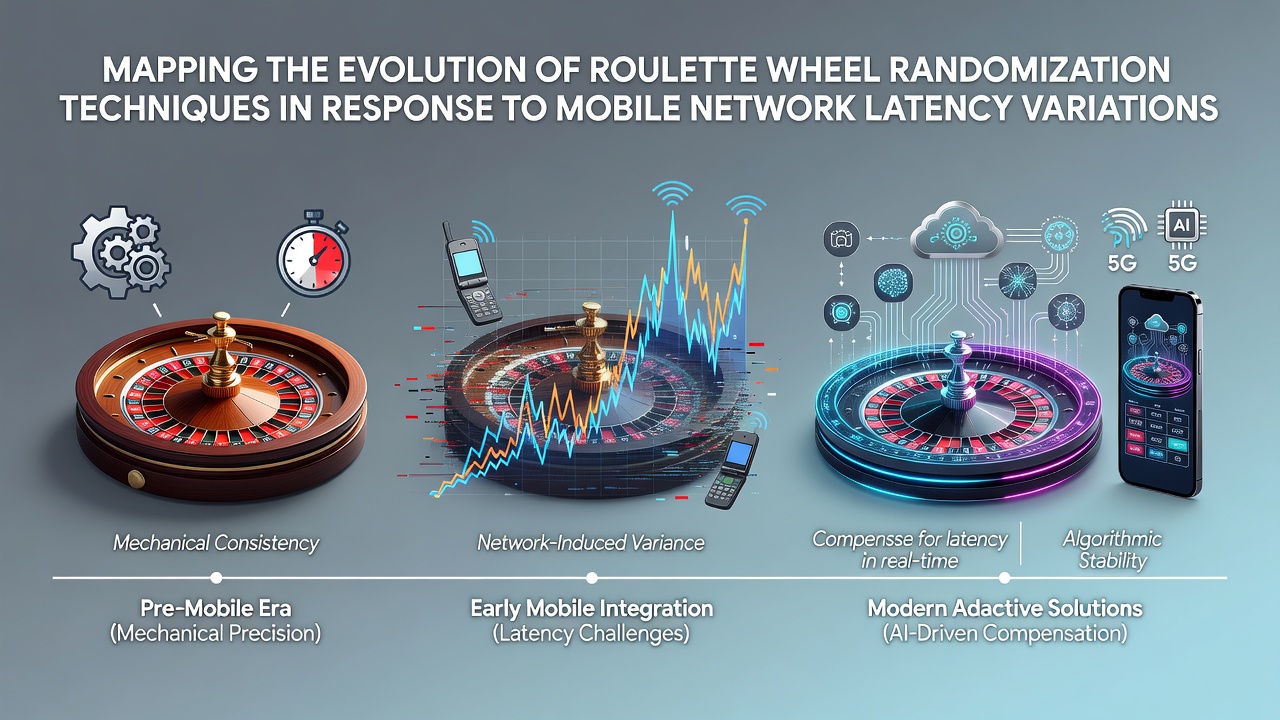
Developments in mobile gaming have driven changes in how online roulette systems generate and deliver random outcomes, particularly when network conditions fluctuate. Early digital roulette platforms relied on fixed random number generator sequences that operated independently of transmission delays, yet as smartphone usage expanded in the mid-2010s operators encountered situations where packets arrived out of order or arrived late, which disrupted the intended timing between wheel spin initiation and result display. Researchers at several technical institutes documented these synchronization issues through controlled tests that measured round-trip times across 3G and early 4G networks, revealing average latencies ranging from 80 to 250 milliseconds depending on signal strength and tower load. Technicians responded by introducing buffering layers that stored multiple pre-computed wheel positions on the client device, allowing the interface to continue displaying smooth animation even when the server confirmation packet experienced temporary lag. This approach preserved the statistical integrity of the underlying algorithm because the random seed remained server-side while only the visual representation shifted forward or backward within a narrow window of acceptable frames. Data collected by network monitoring firms during 2018 and 2019 showed that such buffers reduced player-reported desync events by approximately 62 percent across major European operators.Adaptive Seeding Methods Emerge
By 2021 several providers began testing adaptive seeding protocols that adjusted the random number generation rate in real time based on measured latency samples taken every few seconds. When latency exceeded a predefined threshold the system would switch to a slower but more robust pseudo-random function that required fewer server acknowledgments, whereas low-latency periods allowed faster cycling through the full entropy pool. Engineers at one North American testing laboratory published findings indicating that these switches maintained return-to-player percentages within 0.03 percent of the certified baseline across thousands of simulated sessions.
Another technique involved forward error correction applied directly to outcome packets so that missing fragments could be reconstructed without requesting retransmission, which proved useful on congested urban 4G cells where packet loss rates sometimes climbed above 4 percent. Government regulators in Australia required operators to submit latency compensation logs during licensing renewals starting in 2022, creating a public dataset that later researchers used to correlate regional network quality with observed game fairness metrics.
Integration of Machine Learning Adjustments
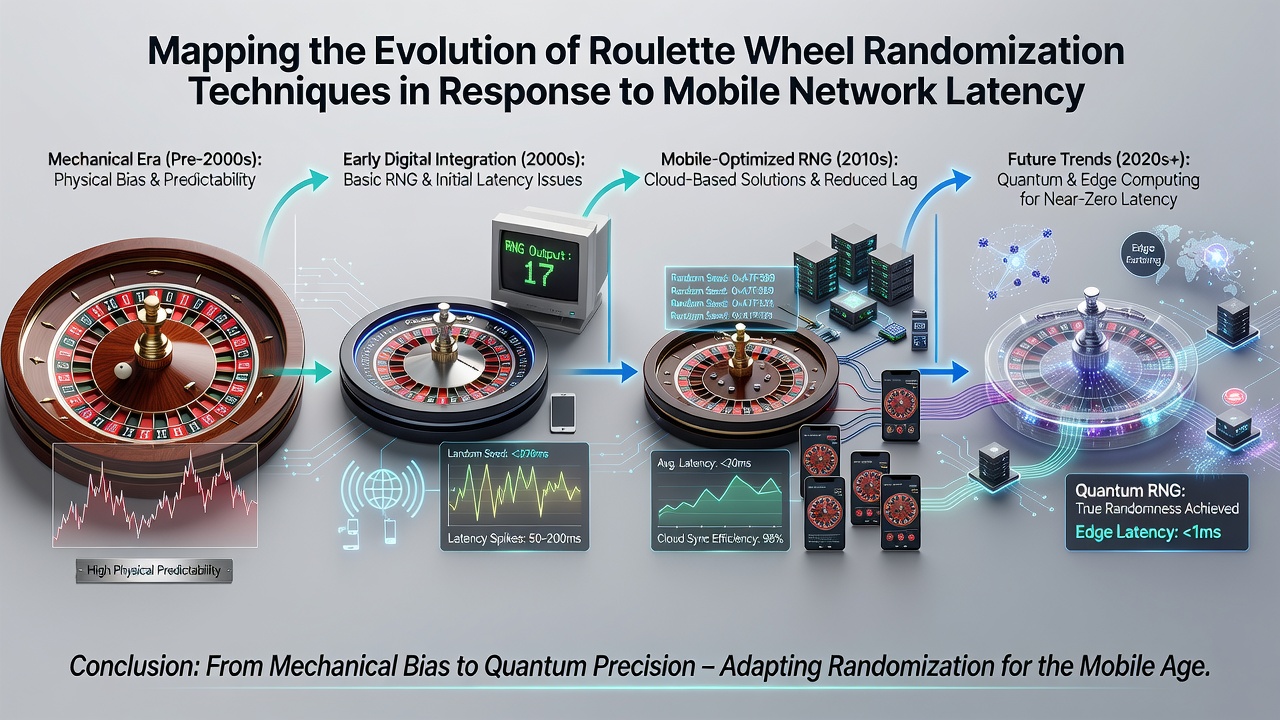
More recent implementations incorporate lightweight machine learning models that predict latency spikes based on historical patterns tied to time of day, geographic location, and device type. These models run on the server and pre-select alternative outcome sequences that align with the expected arrival window on the player device, reducing the need for post-arrival corrections. A 2025 industry report compiled by an international gaming technology consortium noted that operators deploying such predictive layers recorded a 41 percent drop in manual intervention requests from support teams handling mobile roulette complaints.
October 2026 brought further refinement when several major platforms rolled out hybrid systems combining quantum random number sources with latency-adaptive smoothing algorithms. The quantum component supplied fresh entropy at intervals calibrated to average observed round-trip times, while classical fallback generators activated automatically during detected network degradation. Testing facilities in Canada and Singapore verified that the combined approach passed all standard statistical suites even under simulated packet jitter conditions exceeding 300 milliseconds.
Regulatory and Standards Developments
Standards organizations have updated testing protocols to include explicit latency variation scenarios. The Gaming Standards Association released revised certification guidelines in early 2025 that require simulation of variable delay profiles drawn from real-world mobile carrier data across multiple continents. Compliance documentation now routinely contains graphs mapping outcome distribution stability against latency percentiles rather than single average values.
Parallel work at academic institutions has produced open datasets containing anonymized mobile session traces paired with corresponding random sequence logs, enabling independent verification of compensation mechanisms. One university-led project in the Netherlands demonstrated that transparent disclosure of latency handling methods increased player trust scores in controlled surveys, although the study emphasized that trust metrics remained separate from mathematical fairness verification.
Conclusion
Continued expansion of 5G and emerging 6G networks will likely introduce new latency profiles that demand further evolution of roulette randomization logic. Current trajectories point toward tighter integration between network telemetry and entropy management, with systems expected to adjust randomization parameters at sub-second granularity. Observers note that the core requirement remains unchanged: every outcome must retain certified randomness regardless of the path taken through fluctuating mobile infrastructure.